
The Hawaii of Europe
he Canary Islands feel like a little world of their own. Even though they’re part of Spain, because they are just off the coast of Africa, they have that perfect year-round “endless spring” weather that’s hard to beat. There are 8 main islands in the Canary Islands archipelago. While historically known as a group of 7, the islet of La Graciosa was recognized as the 8th inhabited island in 2018.
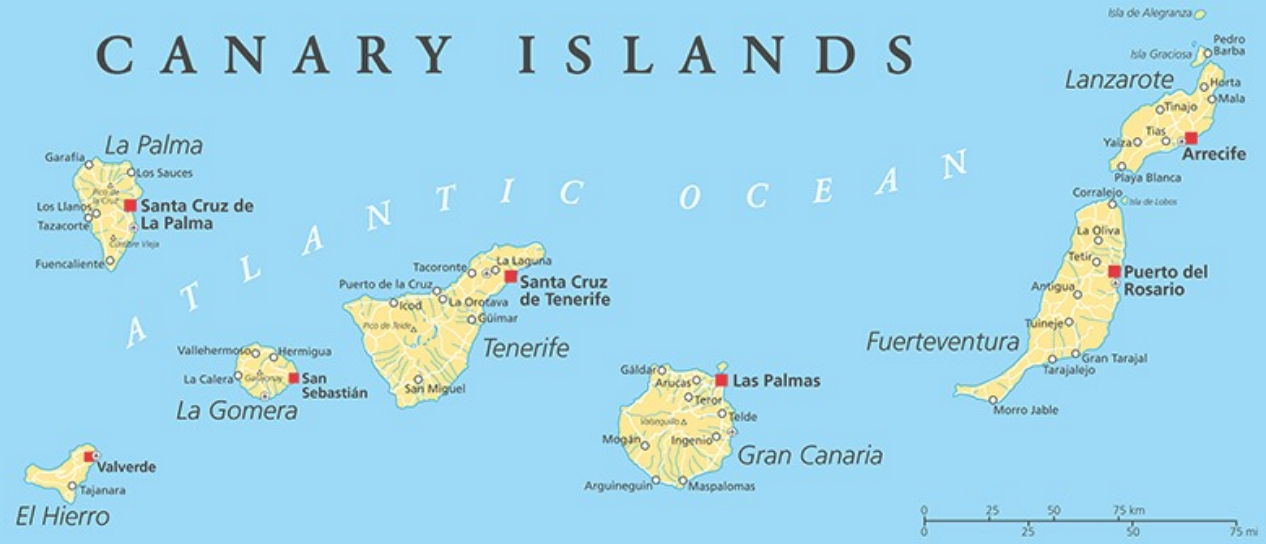
Each island seems to have its own personality. Some feel raw and volcanic, others are green and mountainous, and some are all about beaches, resorts, and dunes. What struck us most was how much variety you can experience in a single day — hiking through lava fields in the morning, swimming in the Atlantic in the afternoon, and sitting outside at a restaurant at night. It didn’t take long to understand why Europeans vacation here year after year.
People often call the Canary Islands the “Hawaii of Europe,” and we can see why. The volcanic landscapes, black-sand beaches, rugged coastlines, and surf culture definitely give off that vibe. At the same time, it still feels distinctly European. With a total population of about 2.2 million, most living on Tenerife and Gran Canaria, the islands host an incredible number of visitors each year. In 2025 alone, there were around 15.7 million foreign visitors, with total visitor numbers likely topping 18 million, with more than half coming from the U.K. and Germany. Interestingly, during our stay, we didn’t come across any other Americans.
Tourism has been impacting the islands, and Spain has been taking steps to manage and limit the impact. There have been growing public protests about housing shortages and environmental strain, leading officials to review short-term rental laws and sustainable tourism policies. The goal isn’t to stop tourism; it’s a huge part of the economy, but to slow uncontrolled growth and reduce pressure on housing, infrastructure, and natural resources
Santa Cruz de Tenerife
We flew into Tenerife from Barcelona, excited to see what the largest of the Canary Islands had to offer. Tenerife really does feel like it has a bit of everything. It’s home to Mount Teide, Spain’s highest peak, which rises above the clouds and creates a dramatic backdrop you can see from almost anywhere on the island. The north feels greener and more traditional, with colorful towns and a stronger local vibe, while the south is sunnier and better known for its beaches and resort areas.
We chose to stay in the north, in Santa Cruz de Tenerife. The city itself has around 210,000 residents, but when you include the surrounding urban area, the population is closer to half a million. As we mentioned in our last blog, Santa Cruz is home to the second-largest Carnival in the world, and experiencing that celebration firsthand was one of the main reasons we wanted to be there. We spent a lot of time at the carnival events, but we still found time to venture out and explore the town and the surrounding area.
Playa de Las Teresitas
A nice way to relax and get away from the carnival is to head to a beach. While the best beaches are in the southern part of the island, this popular beach is right outside the city of Santa Cruz de Tenerife. The wide stretch of golden sand feels almost tropical, especially with rows of palm trees and the dramatic Anaga Mountains rising behind it. Unlike many natural beaches in the Canary Islands that have dark volcanic sand, Las Teresitas was created using sand brought from the Sahara, giving it a completely different look and feel. A long breakwater keeps the water calm, making it perfect for swimming or simply relaxing by the shore. It’s an easy, laid-back place where you can enjoy a coffee, drink, or lunch at a beach café, or just spend a slow afternoon watching the Atlantic roll in.


San Cristóbal de La Laguna
Just a short distance away is what many consider the birthplace of Tenerife. After hopping on the tram, we were in San Cristóbal de La Laguna in less than ten minutes.

The town immediately felt different from Santa Cruz. It has a historic, elegant character, with colorful colonial buildings, quiet pedestrian streets, and a relaxed university-town atmosphere. As the only city in the Canary Islands designated as a UNESCO World Heritage Site, La Laguna has carefully preserved much of its original 15th-century layout. Founded in 1497 by Alonso Fernández de Lugo, who chose an inland location to avoid pirate attacks along the coast, La Laguna became the island’s first capital and the political and cultural center of Tenerife.
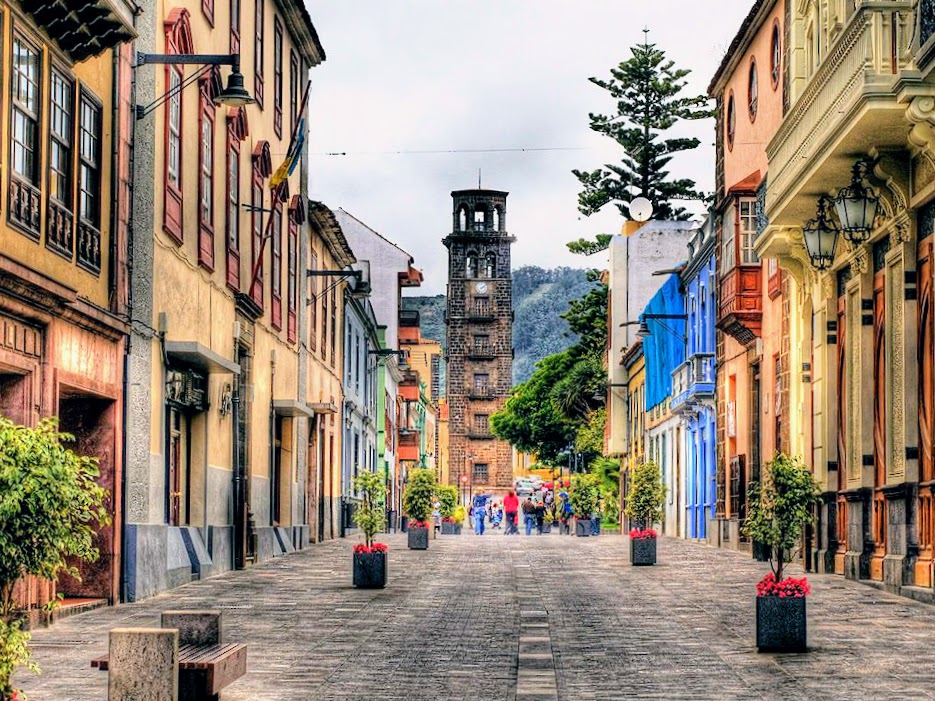
Walking through the old town truly feels like stepping back in time. Its perfectly aligned cobbled streets served as a model for colonial cities in the Americas. We enjoyed a walking tour of the city, popping into small cafés and shops, and admiring the traditional wooden balconies and soft pastel facades. It’s the kind of place where you naturally slow down, less Carnival energy, more history and culture, and it gave us a deeper appreciation for Tenerife.
Food of the Islands
We wanted to take a cooking class, but we couldn’t find one. Instead, we talked to locals about some traditional Canarian foods that we should try. The Canary Islands have their own distinct food culture, influenced by Spain, North Africa, and Latin America, but with ingredients and flavors that are uniquely Canarian. Here are some of our favorites.
Papas Arrugadas con Mojo (Wrinkled Potatoes)
Small local potatoes boiled in very salty water. Skins dried into a salty, wrinkled crust served with Mojo Rojo Sauce (red pepper, garlic, cumin, and olive oil) and Mojo Verde (garlic, olive oil, cilantro, vinegar, and cumin). Simple. Addictive. Served everywhere.

Gofio
Gofio dates back to the Guanche people, the original inhabitants of the islands. They roasted grains (usually barley) and ground them into flour. Today, it’s still made the same basic way: Grains (wheat, corn, sometimes barley) are toasted, then finely ground into flour. The toasting gives it a slightly nutty, almost roasted flavor.

Gofio is served many different ways:
Gofio Escaldado
Mixed with hot broth (often fish or meat stock) and stirred into a thick, savory paste. Served with onions or mojo.
Amasado (Kneaded Gofio)
Broth is added, and it’s shaped into a firm roll and sliced and eaten alongside stews.
Breakfast Style
Mixed into warm milk with sugar or honey.
In Desserts
Used in ice cream, mousse, or flan.
Queso de Cabra Frito (Canarian Fried Goat Cheese)
Queso de cabra frito is one of the most popular tapas dishes in the Canary Islands, and honestly, one of the best things to order with a beer. It’s goat cheese lightly fried until warm inside and crispy outside, served with Mojo Rojo, Mojo Verde, or Miel de palma (palm honey syrup), the classic.

Barraquito – The Canary Islands’ Signature Coffee
Barraquito is a famous layered coffee drink from the Canary Islands, especially Tenerife, and it’s part coffee, part dessert, and part after-dinner drink. Locals sometimes simply order it as “un barraquito” or “zaperoco”.

A traditional barraquito is carefully layered in a glass:
- Condensed milk (sweet base)
- Licor 43 (vanilla-citrus Spanish liqueur)
- Espresso
- Steamed or frothed milk
- Lemon peel
- Cinnamon on top
The layers are usually visible; that’s part of the presentation. Before drinking, you stir all the ingredients to get a sweet and creamy, strong coffee flavor, warm vanilla and citrus flavor, and a little boozy. Perfecto! We found it to be very sweet. I don’t think I could drink one of these every day.
Traditional Spanish Cuisine
Of course, you can find traditional Spanish food all around the Islands. Tapas, thinly sliced cured meats and cheese, fish, paella, croquettes, and one of our favorite, go-to dishes, Tortilla de Patatas (Spanish Tortilla). Potatoes and eggs fried in olive oil.

We thoroughly enjoyed our week in Tenerife. Even though we spent much of our time immersed in Carnival celebrations, the island has much more to offer, including natural landscapes, historic towns, and coastal villages. We found the city to be clean, safe, and easy to navigate, and everywhere we went, the people of Tenerife were warm and friendly.
Now we’re off to the Canary Islands’ most popular island, Gran Canaria. With different scenery and the big city of Las Palmas, we’re excited to explore a new island and see how it compares to unforgettable Tenerife.