Beyond Split and Dubrovnik
The Islands of Croatia
One of the things that makes Croatia’s coastline so fascinating to us is the number of islands scattered across the Adriatic. There are 1,244 islands, islets, rocks, and reefs altogether, including 78 officially classified as islands. With their clear blue water, little harbors, and small villages, it’s easy to imagine spending days exploring them. Each has its own personality, from lively Hvar to historic Korčula and the quieter fishing villages of Vis. Of course, we only scratched the surface, but we did manage to spend some time on a couple of islands and get a little taste of Croatian island life.
Hvar
We spent a day on Hvar, one of Croatia’s best-known islands, exploring Hvar Town, where old stone buildings and narrow streets rise from a beautiful waterfront. The harbor is the town’s heart, with boats bobbing in the clear water and cafés providing a place to sit and watch the activity. Just beyond it, the main square opens up toward St. Stephen’s Cathedral, while the fortress stands high above town. The town is rich in history, but the setting makes it easy to enjoy Hvar simply by walking around.
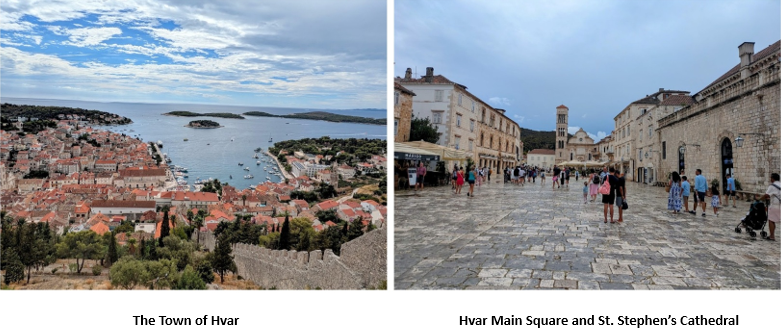
Although Hvar has a reputation for nightlife and glamorous yachts, it also has the charm of an old Adriatic town, with quiet corners tucked away from the busy waterfront. Beyond the town, the island is known for its lavender fields, olive groves, vineyards, and small villages.
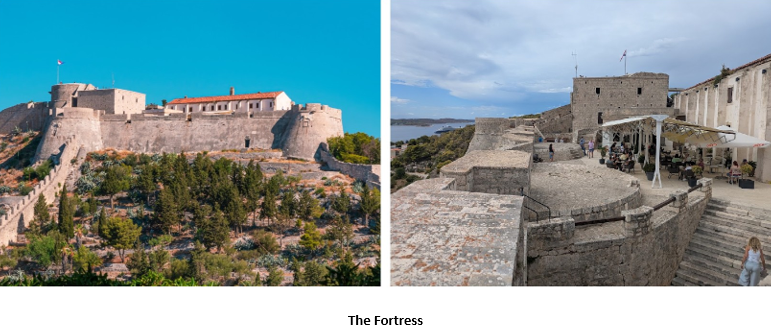
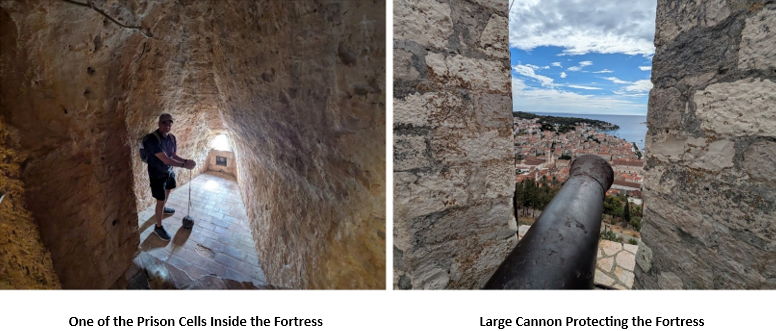
We spent our day hiking up to the fortress, touring its historic theater (one of the oldest public theaters in Europe) and climbing the stairs to the top of the bell tower. The climb to the fortress gave us beautiful views over the town’s red rooftops, the harbor, and the islands beyond. Seeing Hvar from above gave us a real appreciation for its setting along the Adriatic.
We spent the rest of the day wandering the narrow stone streets around the main square and enjoying a nice meal. Between the history, the views, and simply taking our time, it was a relaxing day exploring this beautiful island.
Trogir
We spent another day exploring Trogir, a little town whose historic center sits on a tiny island west of Split, tucked between the mainland and the island of Čiovo. Getting there was easy; we took the bus from Split, then walked across a short bridge from the bus station to one of the old town gates. Once inside, the narrow stone streets led us past old buildings, little shops, and cafés tucked into corners. It’s the kind of place where wandering without much of a plan is part of the fun.
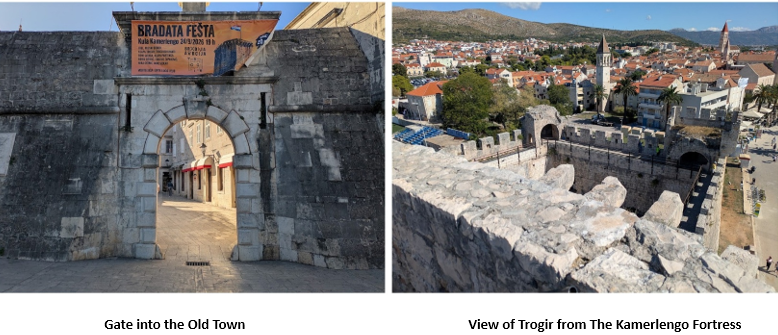
In the main square stands the Cathedral of St. Lawrence, while Kamerlengo Fortress sits at the western end of the waterfront.
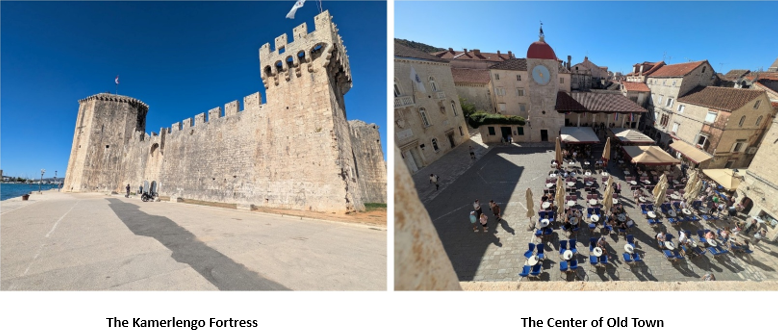
After the close quarters of the winding streets, the wide, palm-lined promenade gives the town a different feel, with boats in the harbor and room to stroll along the water. What we enjoyed about Trogir was how much character it packed into such a small place, a nice little town to explore at our own pace.
Solona
One of the things we have enjoyed about spending time around Split is realizing just how much history is sitting right beneath your feet. A short distance outside the city, we visited Salona, the ruins of what was once the capital of the Roman province of Dalmatia. Nearly 2,000 years ago, this was a busy Roman city with baths, temples, an amphitheater, an aqueduct, and later, some of the earliest Christian churches in the region.
Today, much of Salona is scattered across open fields, and you can just walk among the old stone walls, columns, tombs, and foundations. What we really liked was how quiet and uncrowded it felt. There weren’t barriers everywhere or the sense that we were being shuffled through a tourist attraction. We just walked around at our own pace and imagined what this place must have looked like when thousands of people lived here.
This was also the world of Gaius Aurelius Valerius Diocletianus, better known simply as Diocletian, who ruled the Roman Empire from AD 284 to 305. Diocletian was born in this part of Dalmatia, probably somewhere near Salona, so this area was part of his world. While he was emperor, Salona was the capital and most important city in the Roman province of Dalmatia. Toward the end of his reign, Diocletian had his enormous retirement palace built along the coast just a few miles away. When he stepped down as emperor in AD 305, he retired there. Centuries later, that palace would become the heart of modern-day Split.
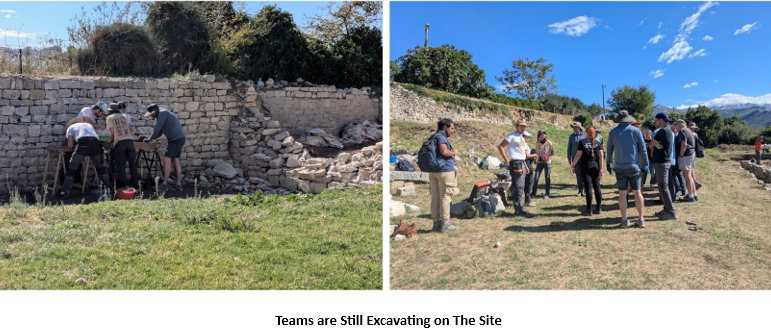
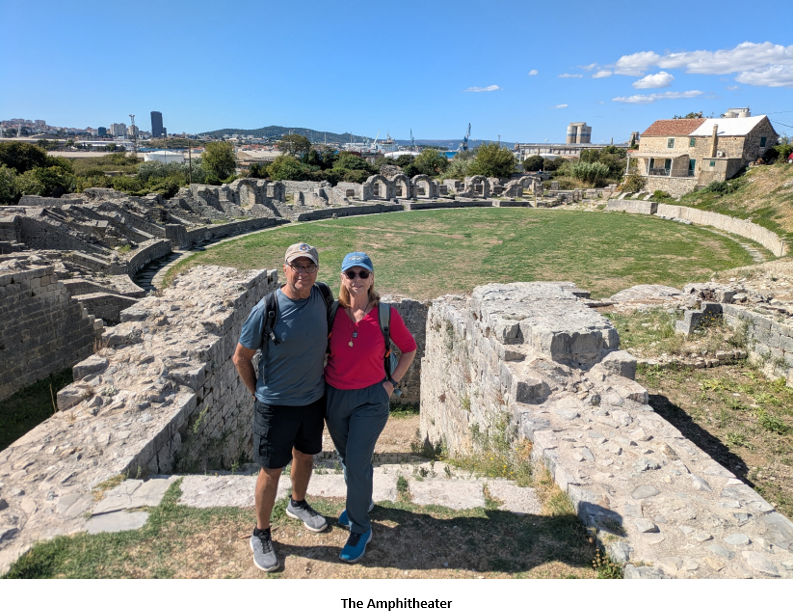
Knowing this made our visit to Salona even more interesting. We had already walked through Diocletian’s Palace in Split, and now we stood among the ruins of the Roman city that existed alongside it. At the time, Salona was an important city, and the palace was its impressive neighbor. Centuries later, after Salona was attacked and abandoned, some of its residents fled to the safety of the old palace walls. Over time, they built homes, shops, and churches within those walls and helped turn the former imperial palace into a living city.
Walking around Salona gave us a completely different perspective on Split. We weren’t just looking at another collection of Roman ruins; we were seeing an earlier chapter of the same story. Salona was the great Roman city that came first, and when it faded away, Diocletian’s Palace became the place where a new city began to grow. That city eventually became the city of Split.
Cavtat
After 16 days in Split, we decided it was finally time to “split” and head to one more town before heading back to the United States. We were looking for someplace a little quieter and less touristy, where we could slow down, relax, and enjoy our last few days in Croatia. We also wanted to be close to the airport, to make our departure as easy as possible.
So, we hopped on the ferry one more time and headed south toward Dubrovnik. It was a nice way to leave Split, cruising down the Adriatic coast. Dubrovnik was the ferry’s final stop, and once we arrived, we grabbed an Uber and headed about 20 minutes south to the small seaside town of Cavtat.
To be honest, we really didn’t know what to expect from Cavtat. All we knew was what we had seen when we first arrived in Croatia and drove through the area on our way from the airport to Dubrovnik.
We rented an apartment up the side of the mountain overlooking the sea and part of the coastline. The view was beautiful, but as we have learned more than once during this trip, a great view usually comes with a price: hills and steps! Just like several of the other apartments we stayed in along the way, getting down to the center of Cavtat was the easy part. Getting back home was another story. There were plenty of hills and steps between us and the waterfront, but by this point in our trip, climbing back to an apartment had become a pretty normal part of life in Croatia.
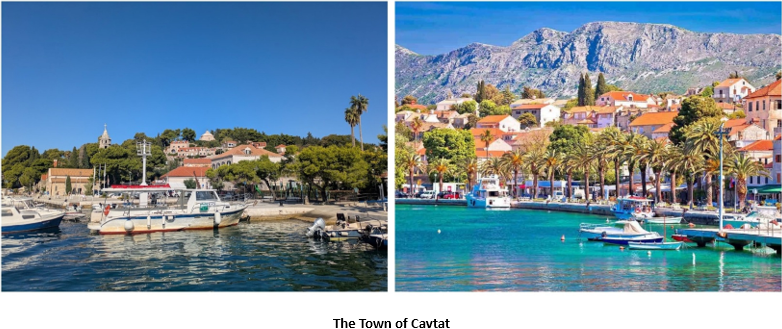
Cavtat is a small seaside town about 15 miles south of Dubrovnik. What surprised us was that Cavtat is actually much older than Dubrovnik. The settlement here dates back to ancient Greek and Roman times, when it was known as Epidaurum and became an important Roman town along the Adriatic coast. In the 7th century, Epidaurum was attacked and largely abandoned. Some of its residents fled north along the coast and helped establish the settlement that eventually grew into Dubrovnik. So, in a way, little Cavtat was here long before its much more famous neighbor.
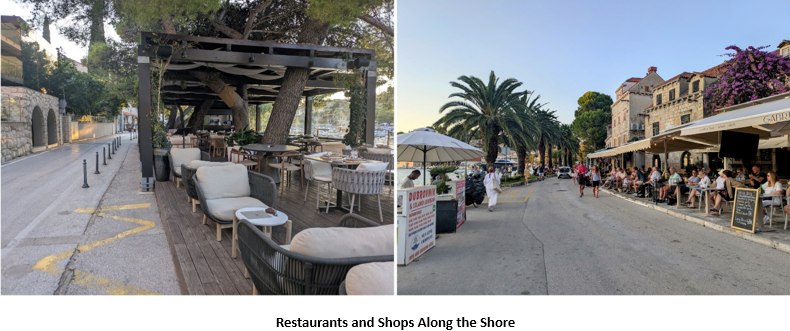
Today, Cavtat is built around a beautiful harbor lined with cafés, restaurants, and small boats, with a waterfront promenade that wraps around the wooded peninsula. The old town has narrow stone streets, historic churches, and centuries-old buildings, but the whole place feels much more relaxed than nearby Dubrovnik. You can walk along the water, stop for a coffee or a meal overlooking the harbor, find a quiet spot to swim, or simply sit and watch the boats come and go.
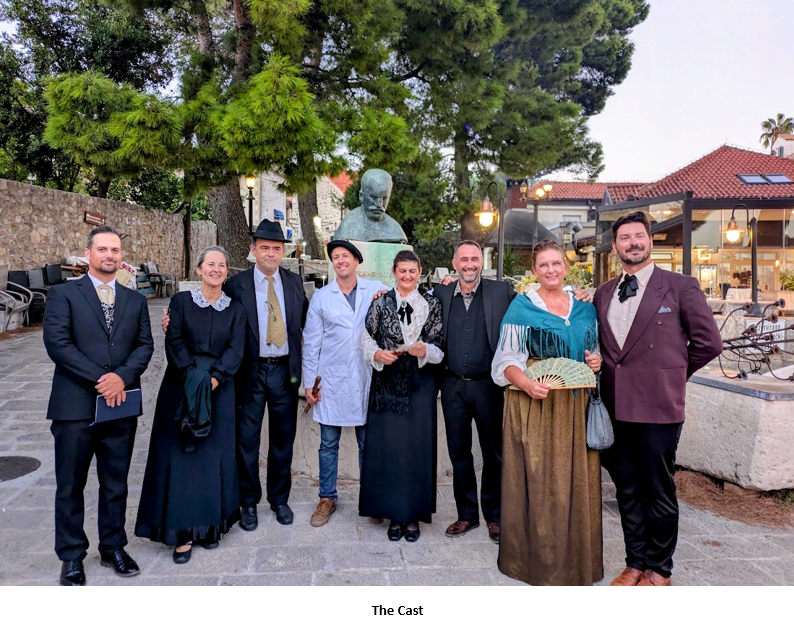
Every Tuesday during tourist season, Cavtat offers a walking tour that is a little different from the usual guided tour. Residents dress in period costumes and take on the roles of some of Cavtat’s most prominent historical figures. Best of all, the tour is free.
As we were guided through town, we met these characters along the way, each telling their own story and explaining the role they played in Cavtat’s history. Instead of simply listening to a guide talk about people who lived here long ago, the characters came to life right in front of us. Each shared who they were, what they accomplished, and the contribution they made to the town. It was really a combination of theater, history, tourism, and entertainment, all rolled into one, and a fun way to learn a little about Cavtat’s past while exploring the town.
It didn’t take us long to explore Cavtat, and that’s really part of its charm. There was no long list of things we felt we had to see or do, which was exactly what we were looking for. After more than 3 weeks of moving around Croatia, sightseeing, climbing hills, walking countless steps, and exploring one historic town after another, Cavtat felt like the perfect place to slow down, enjoy the Adriatic for a few more days, and begin winding down our trip before heading home.