
Monte Albán – White Mountain
Before arriving in Oaxaca, we knew it was famous for its food, colorful markets, and stunning architecture. What we did not fully appreciate was just how deep its history runs. The state of Oaxaca lies within what archaeologists call Mesoamerica, a large cultural region that stretched across central and southern Mexico and into parts of Central America.
Long before Europeans arrived, this region was home to great civilizations such as the Maya, Aztecs, Mixtecs, and Zapotecs. Each had its own language, customs, and cities, yet they shared many common traditions, including agriculture based on corn, complex calendars, pyramid temples, and extensive trade networks.
We have written about some of these civilizations in previous blogs. We have toured many ancient ruins in Mexico and South America. Sometimes it’s hard to put all these different civilizations into perspective. So here is a simple little table that shows some of the great civilizations in Mesoamerica.
| Civilization | Approximate Dates | Golden Age / Peak Period | Major Centers | Status Today |
|---|---|---|---|---|
| Zapotec | 500 BC – Present | 500 BC – AD 800 | Monte Albán,
Mitla |
Still living in Oaxaca |
| Mixtec | 1500 BC – Present | AD 900 – 1521 | Tututepec, Tilantongo, Zaachila | Still living in Oaxaca |
| Maya | 2000 BC – Present | AD 250 – 900 | Tikal, Palenque,
Chichén Itzá |
Still living throughout Mexico and Central America |
| Aztec (Mexica) | AD 1325 – 1521 | AD 1428 – 1521 | Tenochtitlan | Empire ended in 1521; descendants remain throughout Mexico |
Of all these civilizations, it is the Zapotecs who are closely tied to Oaxaca. More than 2,500 years ago, they built the mountaintop city of Monte Albán, one of the earliest and most important urban centers in the Americas.
Monte Albán
Monte Albán is the ancient capital of the Zapotec civilization and one of the most important archaeological sites in all of Mesoamerica. Founded around 500 BC, it sits atop a flattened mountain ridge overlooking the Oaxaca Valley. At its peak, it was a thriving city of political, religious, and economic power that dominated much of southern Mexico for nearly 1,300 years.
Despite its ancient origins, Monte Albán is not an ancient Zapotec name. The name used today was given during the Spanish colonial era and is usually translated as “White Mountain.” The original name of the city has been lost to history. Some scholars believe the Zapotecs may have called it Dani Baá, often interpreted as “Sacred Mountain,” although there is no evidence to confirm this.

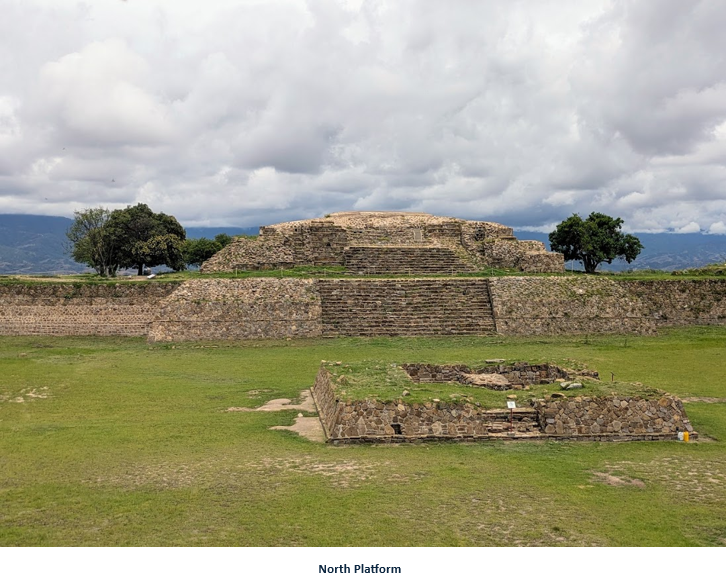
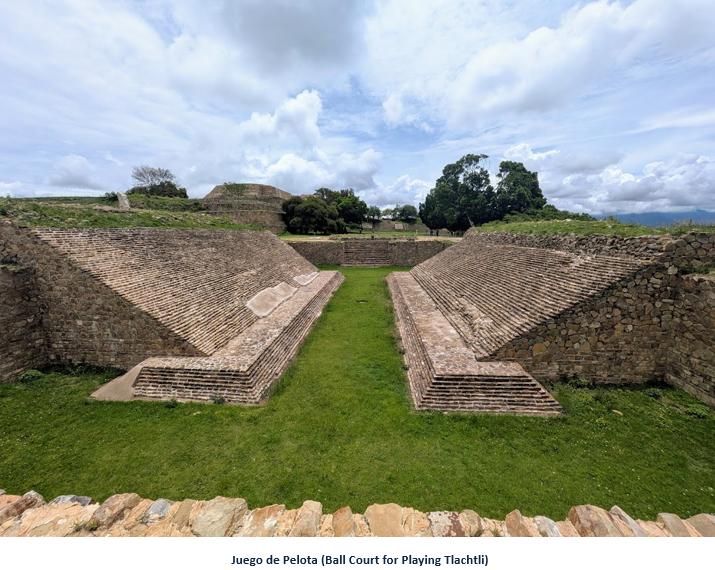
What makes Monte Albán remarkable is its location. The Zapotecs literally reshaped the top of a mountain, creating enormous plazas, temples, pyramids, terraces, and ceremonial platforms. Standing in the center of the Great Plaza today, you can see almost the entire Oaxaca Valley spread out below you.
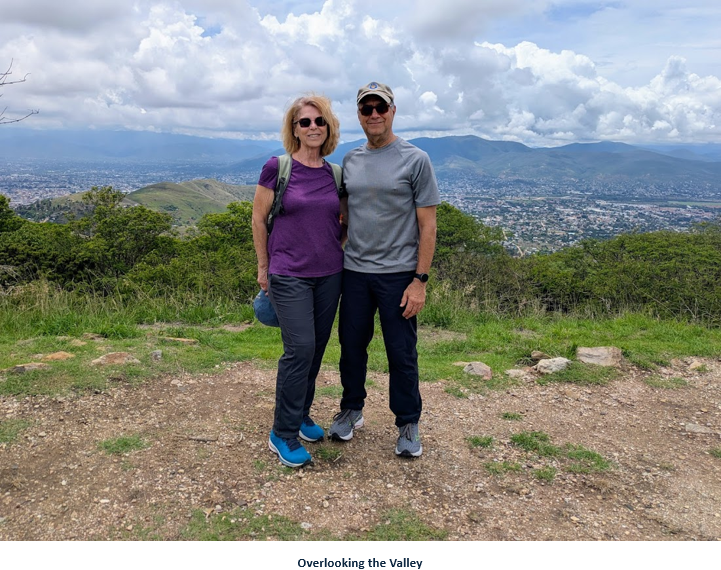
Around 800 to 900 AD, Monte Albán began to decline and lose population. Mixtecs became the dominant power in much of Oaxaca and reused parts of Monte Albán,
By the time the Mixtecs began using Monte Albán, the city was no longer a thriving urban center. Most of its population had already left, and political power had shifted elsewhere. Rather than rebuilding the city as their capital, the Mixtecs treated Monte Albán as a sacred ancestral site.
Tomb 7
There were as many as 170 tombs discovered at Monte Alban, all of which were filled with paintings, carvings, and other artifacts. The tombs in Mesoamerica were chamber-like burial locations that were spacious enough to hold the remains of one or more individuals, as well as any material items.
The most famous discovery was Tomb 7, excavated by Mexican archaeologist Alfonso Caso in 1932. It contained one of the richest collections of pre-Hispanic gold, jewelry, and artifacts ever found in Mexico.

The tomb contained nine skeletons and more than 500 grave offerings, making it one of the richest archaeological discoveries ever made in the Americas. Among the burials was a person archaeologists designated as “Individual A.” This individual was found with a human skull covered in turquoise and shell mosaic plaques, along with a flat shell ornament projecting from the nasal cavity. The elaborate burial suggests the individual held an important position in Mixtec society and reflects the extraordinary craftsmanship for which the Mixtecs became known.
We had the opportunity to see Individual A and many of the other artifacts recovered from Tomb 7 during our visit to the Museum of Cultures of Oaxaca, housed within the former Santo Domingo monastery in central Oaxaca.

What makes the tomb remarkable is not only the incredible treasures found inside, but the fact that they survived at all.
By the time the Mixtecs became the dominant culture in Oaxaca, Monte Albán was no longer a bustling city. Instead, it had become a sacred place. The Mixtecs continued to honor the site and reused some of the older Zapotec tombs for their own elite burials. Tomb 7 was one of them. While most of the other tombs were looted over the years, somehow, its entrance remained hidden beneath centuries of rubble, soil, and vegetation, allowing its treasures to remain untouched.
Continuation of Zapotec
Monte Albán and the Historic Center of Oaxaca were jointly designated a UNESCO World Heritage Site in 1987 because of their extraordinary cultural significance and preservation.
But the Zapotec story does not end with the decline of Monte Albán. Unlike many ancient civilizations, the descendants of the Zapotecs still live here today. Their languages are still spoken, their traditions are still practiced, and their communities remain an important part of life throughout the state. In many villages, weaving, pottery, farming, and community customs reflect traditions that have been passed down for generations.
What made our visit to Monte Albán special to us was our guide. Rather than simply telling us about the Zapotec people, he is of Zapotec decent. He grew up and lives in one of the local communities, speaks the Zapotec language, and continues to practice many of the traditions that have been handed down through his family. Listening to him describe the culture transformed our visit from a lesson about an ancient civilization into a conversation with someone living its legacy today.
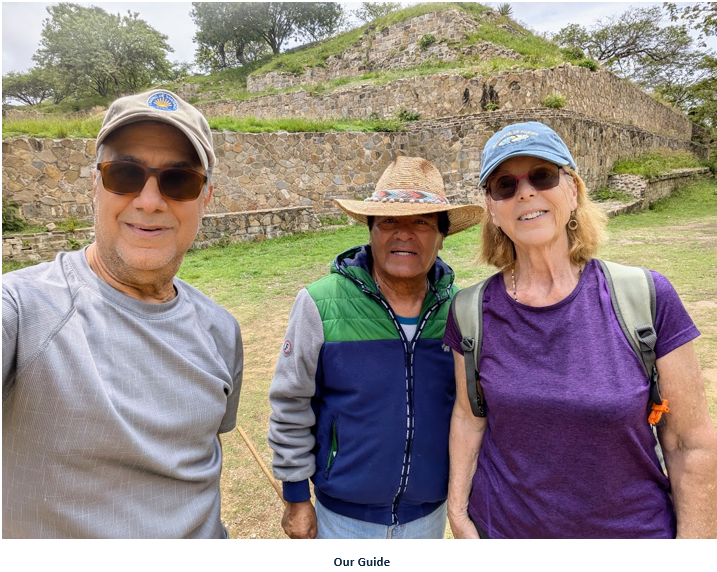
It’s one thing to stand among the ruins of Monte Albán and imagine the people who once lived there. It’s quite another to realize that their descendants are still here, speaking their language, preserving their customs, and carrying their history forward.
3 thoughts on “Monte Albán – White Mountain”
I always enjoy your posts and the history lessons that they are. Your pictures are wonderful and it’s good to see you guys in some of them.
Thanks Stephen. Its good to hear from you.
I hope all is well and you’re enjoying retirement.
Thank you for sharing the experience. Enjoy your adventure!